Falling Teacups
Robert Russell at Miles McEnery Gallery | New York, NY

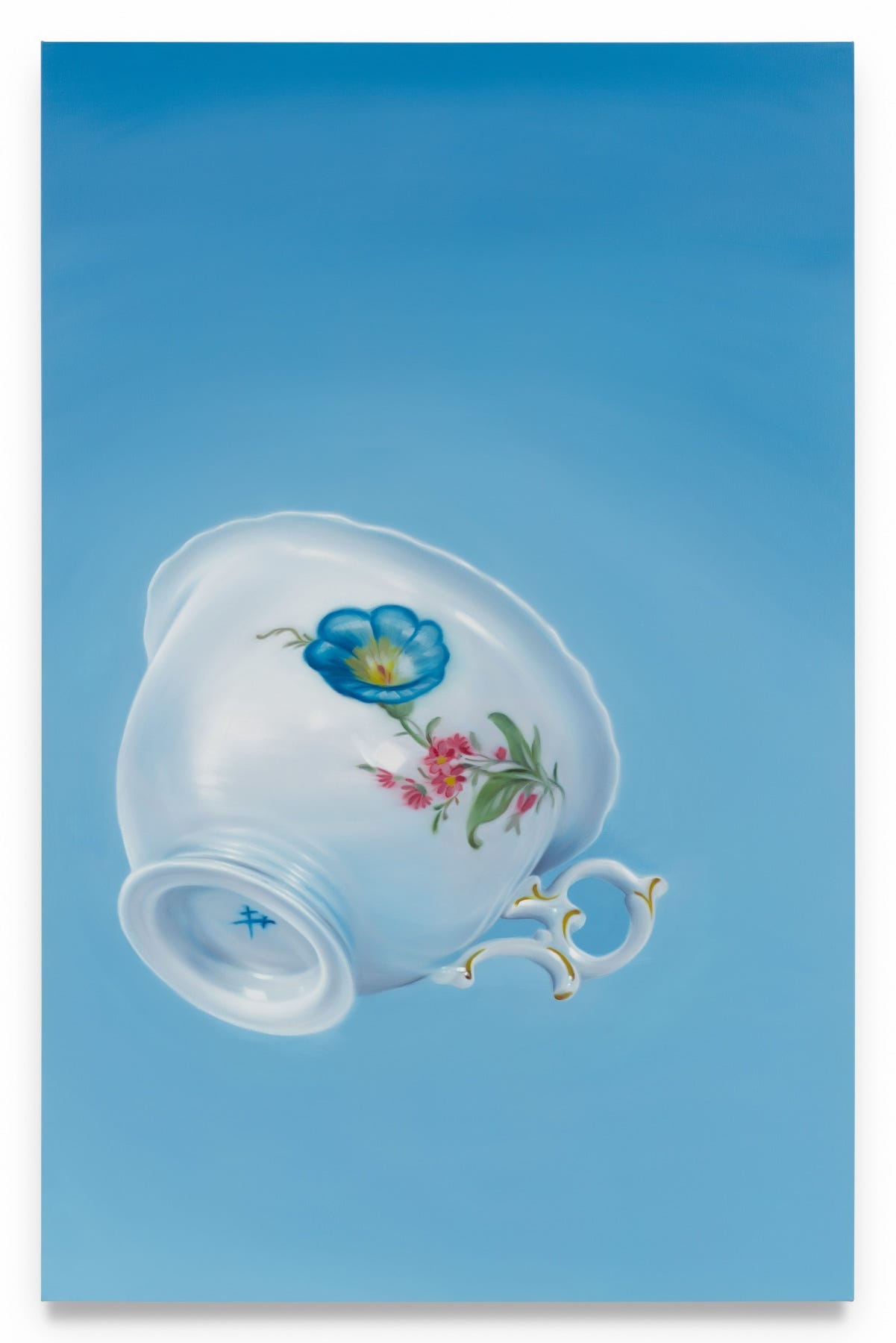
Falling Teacup #13, 2024, Oil on canvas, 70 x 60 inches
It’s been a minute since I wrote about actual works of art, so if you’ve been missing that, today is your lucky day. I have certainly been missing it, too, and when I saw that one of my favorite artists, Robert Russell, was having another solo exhibition at Miles McEnery Gallery in New York, I knew I had to write a “review.” I put that in quotes because I have not seen the show in person, but due to the magic of the internet, I feel as though I have enough to go on from my couch in NC. Please enjoy, especially if this artist is new to you.
If you follow the work of American painter, Robert Russell (b. 1971), you have witnessed the evolution of his subject matter. Over the years, he has produced series of self-portraits, imaginary artist monographs and figurative works. He is a true photorealist, working from photographs he sources largely online. Most recently, he has taken on single-object still life—a genre that I am particularly inclined towards. These still life paintings were my personal introduction to Russell on Instagram, likely through Miles McEnery Gallery. In researching Russell for the purposes of this review, I learned that he began painting teacups in 2020 as a sort of vanitas or memento mori. The teacups I first saw were of monumental scale and had void-like black backgrounds. They felt important—contemporary in a way that representational art does not always feel. What fascinated me most about them was the way in which Russell captured the gleam of a vintage porcelain teacup. The teacups were rendered crisply enough to convey the smooth, glazed surface, yet softly enough to avoid appearing cold or slick. I was instantly transfixed and began following his work.
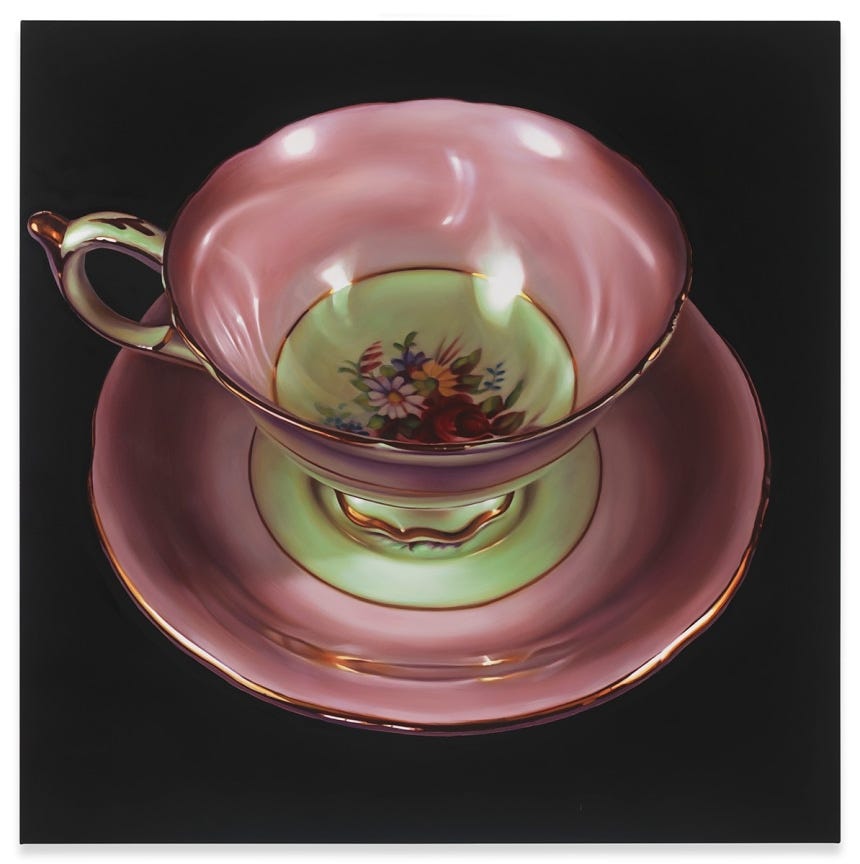
Teacup #29, 2021, Oil on canvas, 70 x 70 inches
The next series I saw Russell take on was one of Allach figurines. These figurines are porcelain, much like a teacup, and look similarly charming and vintage. Again, I was taken with their shininess and sweeping contours, but they took on a new meaning when I later learned what they actually were. What separates a Allach figurines from an average tchotchkes is how and when they were made. The Allach factory, located in Germany, was seized and controlled by Nazis in 1939. From then on, the figurines and other porcelain pieces manufactured there were made by forced labor and stamped with SS runes. Russell learned of Allach figurines while researching for more teacup paintings, and felt as though he had a responsibility to bring them to light. He is of Jewish faith and wanted to paint the objects as a means of reclaiming them. He chose to do so on a monumental scale yet again, but this time, the monumentality was not to make them feel significant. Instead, it served to make them feel appropriately beast-like. He exhibited the Allach figurines at Anat Ebgi in 2023 .
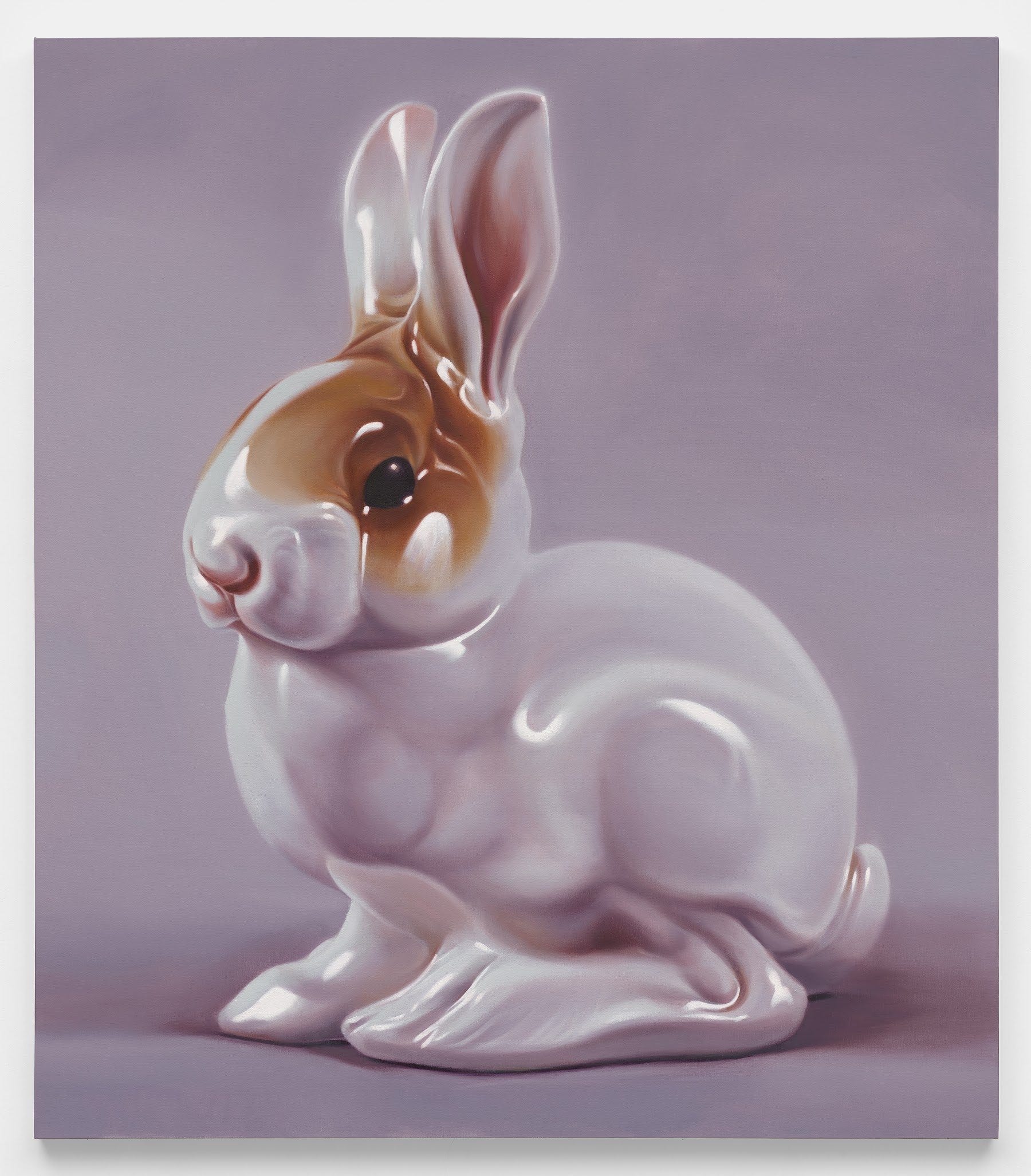
Junger Hase Sitzend, 2023, Oil on Canvas, 80 x 70 inches
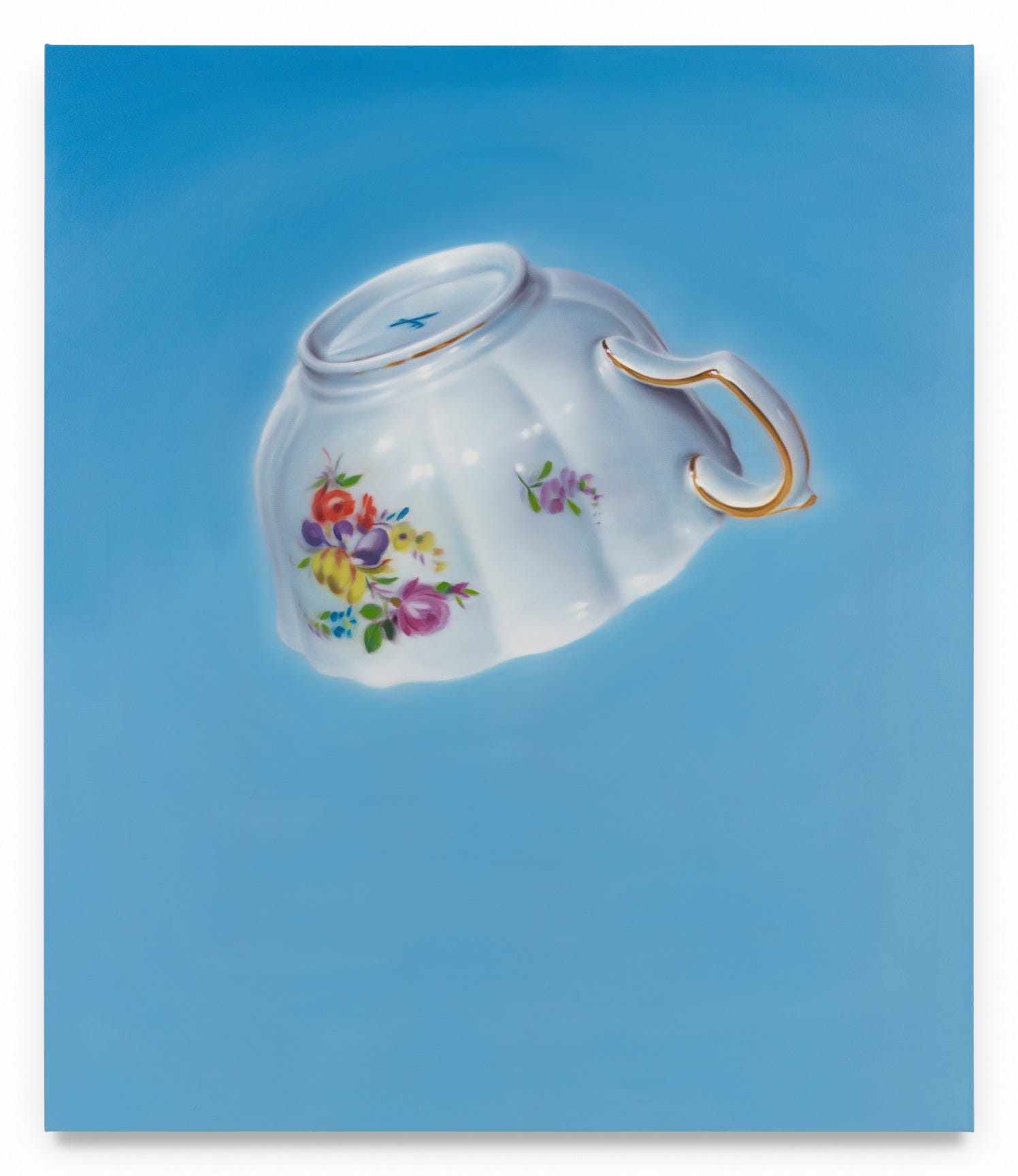
This brings us to the current Falling Teacups exhibition at Miles McEnery Gallery in New York. Obviously, the teacups have made their return, but Russell treats them differently this time. He has traded black backgrounds for pale blue, and the teacups no longer sit on an implied surface. Instead, they are suspended in air, captured on the picture plane in mid-fall. The viewers’ eyes are locked on this frozen moment, knowing the cup will inevitably crash and shatter, but unable to see how or when. This is another allusion to the fleeting nature of life, and it also alludes to the murkiness of the future. Each living person knows that life ends in death, but the action leading up to that end cannot be seen before it is lived. I learned from the catalogue essay for this exhibition, too, that Russell was thinking a lot about fine china and how it’s almost never used. People save up their finery for special occasions and sometimes forget to use it at all. Having recently been married and registering for this exact type of china, and having yet to use it, I can understand this paradox. It’s intriguing that Russell links this phenomenon to death—much of his source imagery comes from estate sales—and the way we sell off precious items when a loved one dies. The tumbling teacups then become a metaphor for the limbo in which our possessions reside. They also remind us to make use of those possessions because there are no dress rehearsals for life, as they say.
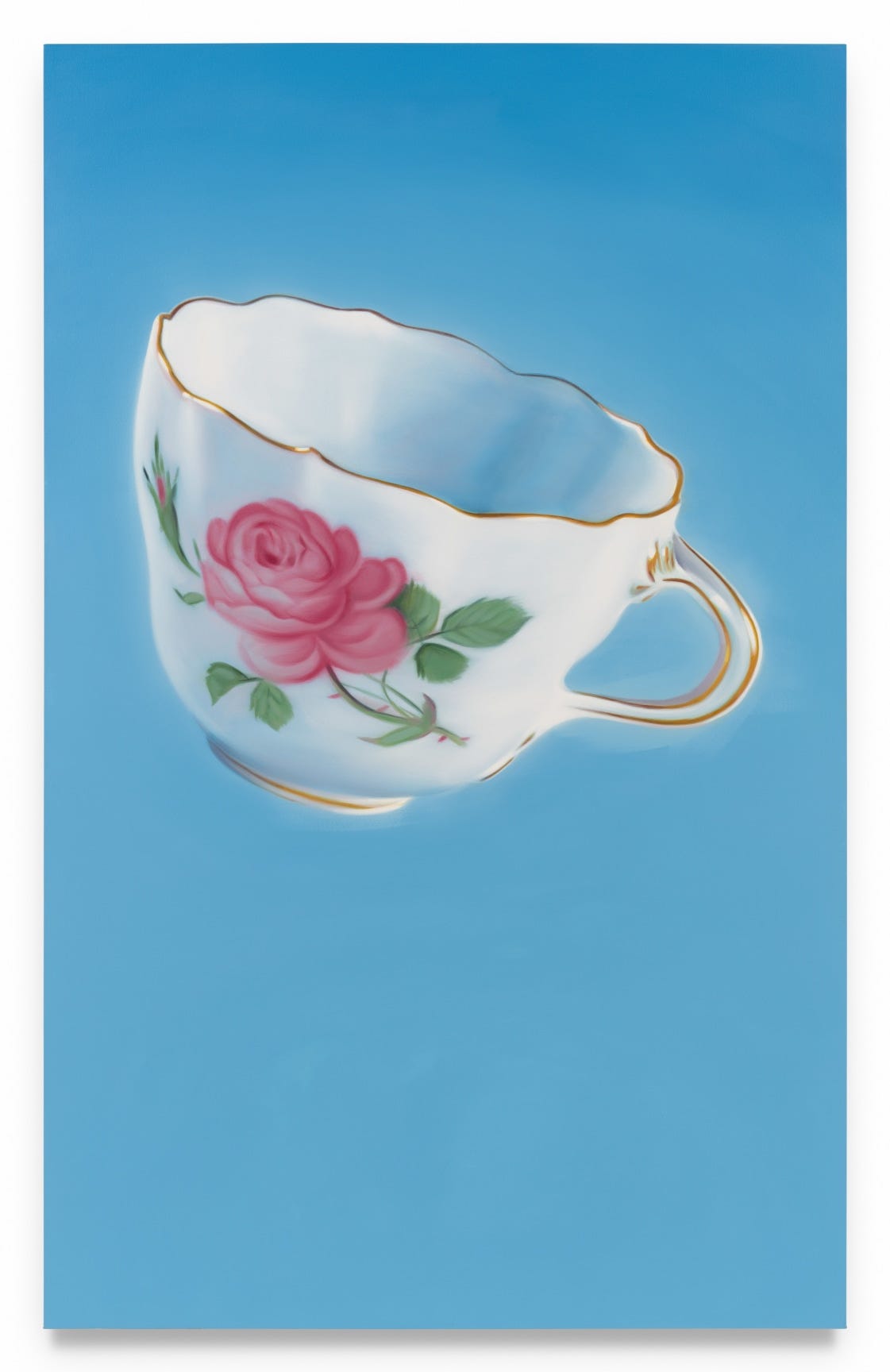
Falling Teacup #6, 2024, Oil on canvas, 80 x 50 inches
Falling Teacups is an innovation in the tradition of still-life itself. As the teacups fall, they twist and tumble at odd angles, revealing their undersides and manufacturers stamps. Sometimes they are frozen in unexpected areas of the picture plane. The movement reveals to viewers everything that the artifice of still life aims to conceal. This feels metaphorical, too, in a world that is preoccupied with image, but increasingly thrown into the type of chaos that upends everything it touches.
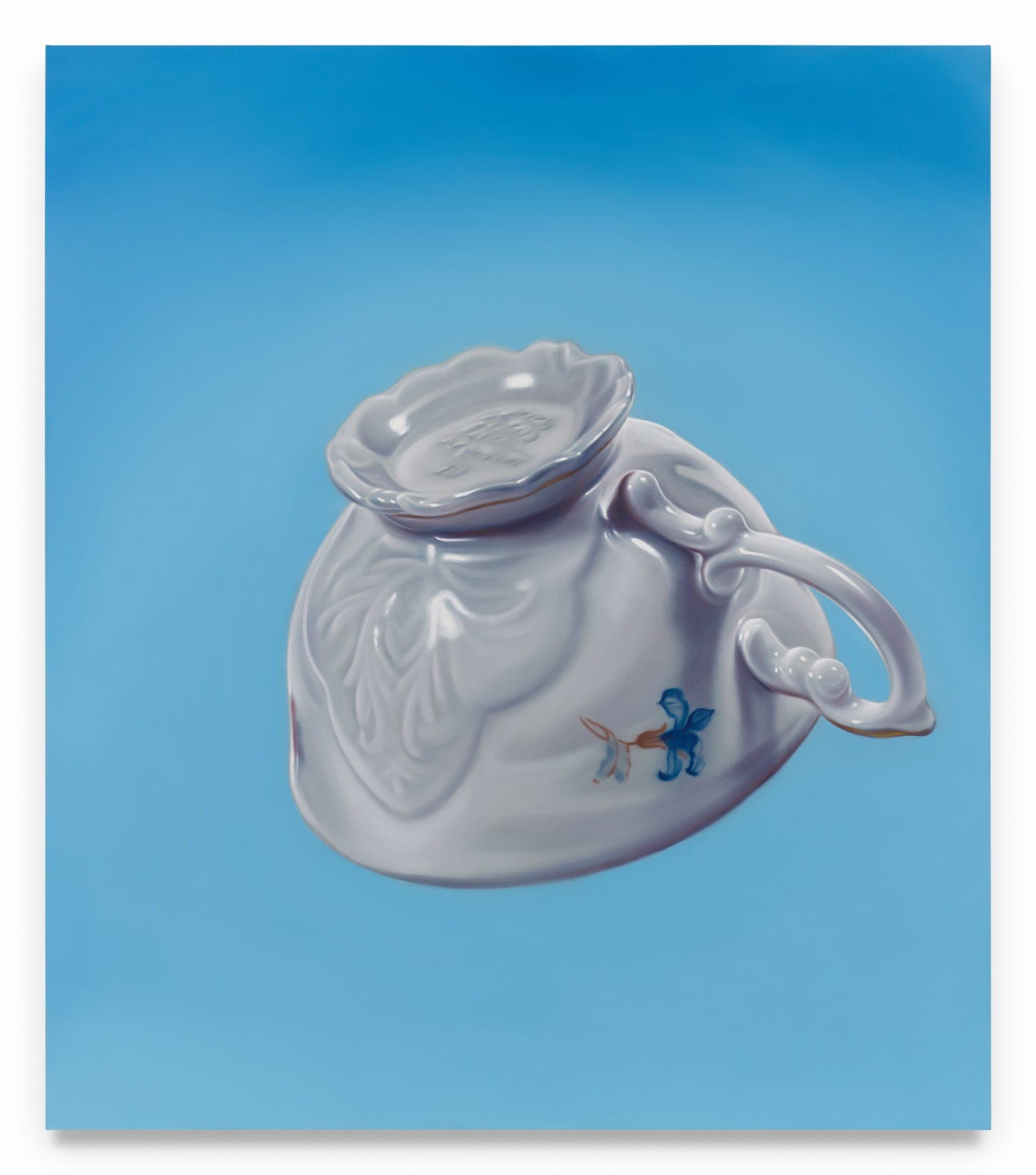
Falling Teacup #4, 2024, Oil on canvas, 80 x 70 inches
Robert Russell’s work within Falling Teacups and beyond is a lesson in the power of good painting. What appear to be beautiful works of art in their own right are exposed to contain multitudes of meaning and significance upon further examination. Chouette is a project that reveres beauty as a standalone principle, but it is not one that seeks to ignore depth. The best case scenario in art, as in life, is when something appears beautiful and has something to say. Robert Russell is an artist who toes that line brilliantly.
Falling Teacups opened on July 3 and is on view through August 23, 2024 at Miles McEnery Gallery in New York. You can view the exhibition catalogue and images here. You can visit the exhibition in person at 515 West 22nd Street.